Baltic Way 2017 · Problem 11
Geometry
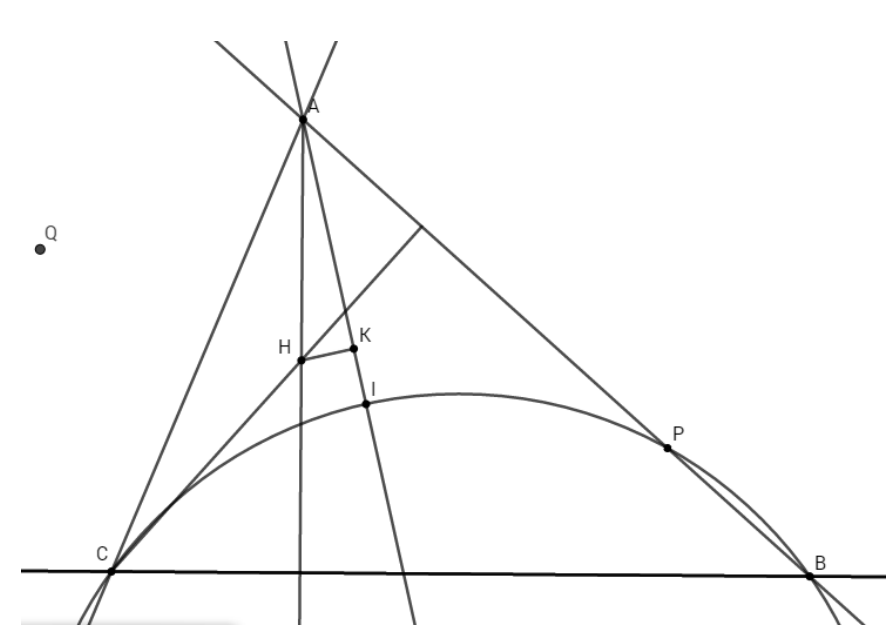
Let and be the orthocentre and incentre, respectively, of an acute angled triangle . The circumcircle of the triangle intersects the segment at the point different from . Let be the projection of onto and the reflection of in . Show that and are collinear.
When you’re ready
Review material becomes available with the next Daily.
Review
Topics
Circles and tangency · Cyclic geometry · Triangles and centers
Solutions
Solution 1
Let be the reflection of in . The reflection about the point sends to , and the line to the line through and orthogonal to . The reflection about the line sends to , and the line through orthogonal to to the line through orthogonal to , but this is just . Since composition of the two reflections sends and to the same line, it follows that and are collinear.
Solution 2
Let , and . Clearly then , which yields . From this we get , so triangle is isosceles.
Now since is the anglebisector of it must also be the perpendicular bisector of . Hence so triangle is isosceles. Additionally bisects so is the midline of triangle parallel to . Since is perpendicular to , it is also perpendicular to , so we may then conclude by symmetry that is also isosceles. Moreover , and , so , which means that triangles and are similar. In particular we have . Since also
it follows that , and are collinear.
To prove that always lies outside of triangle one could do the following: Since lies on , angle is larger than angle in triangle . Thus angle is obtuse, where is the intersection point between and . As and are parallel, angle is obtuse. Thus lies outside of triangle .
Contest context
Results from Baltic Way 2017
11 teams
- Mean score
- 1.5 / 5
- Scores of 4 or 5
- 2 / 11
- Estonia
- 2 / 5
Score distribution
All team scores
| Team | Score |
|---|---|
| St. Petersburg | 0 / 5 |
| Germany | 5 / 5 |
| Poland | 1 / 5 |
| Denmark | 2 / 5 |
| Estonia | 2 / 5 |
| Lithuania | 2 / 5 |
| Sweden | 0 / 5 |
| Norway | 0 / 5 |
| Finland | 0 / 5 |
| Iceland | 0 / 5 |
| Latvia | 4 / 5 |