Balti Tee 2017 · Ülesanne 11
Geomeetria
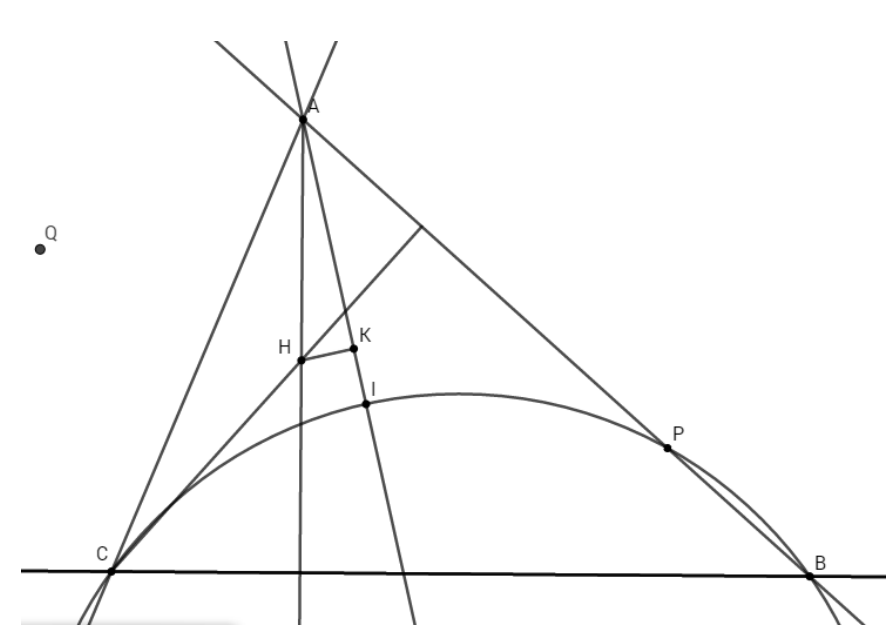
Let and be the orthocentre and incentre, respectively, of an acute angled triangle . The circumcircle of the triangle intersects the segment at the point different from . Let be the projection of onto and the reflection of in . Show that and are collinear.
Kui oled valmis
Ülevaatematerjal muutub kättesaadavaks järgmise päevaülesannete komplektiga.
Ülevaade
Teemad
Ringjooned ja puutujad · Tsükliline geomeetria · Kolmnurgad ja märkimisväärsed punktid
Lahendused
Lahendus 1
Let be the reflection of in . The reflection about the point sends to , and the line to the line through and orthogonal to . The reflection about the line sends to , and the line through orthogonal to to the line through orthogonal to , but this is just . Since composition of the two reflections sends and to the same line, it follows that and are collinear.
Lahendus 2
Let , and . Clearly then , which yields . From this we get , so triangle is isosceles.
Now since is the anglebisector of it must also be the perpendicular bisector of . Hence so triangle is isosceles. Additionally bisects so is the midline of triangle parallel to . Since is perpendicular to , it is also perpendicular to , so we may then conclude by symmetry that is also isosceles. Moreover , and , so , which means that triangles and are similar. In particular we have . Since also
it follows that , and are collinear.
To prove that always lies outside of triangle one could do the following: Since lies on , angle is larger than angle in triangle . Thus angle is obtuse, where is the intersection point between and . As and are parallel, angle is obtuse. Thus lies outside of triangle .
Võistluse kontekst
Balti Tee tulemused 2017
11 võistkonda
- Keskmine tulemus
- 1,5 / 5
- 4 või 5 punkti
- 2 / 11
- Eesti
- 2 / 5
Punktijaotus
Kõigi võistkondade punktid
| Võistkond | Punktid |
|---|---|
| St. Petersburg | 0 / 5 |
| Germany | 5 / 5 |
| Poland | 1 / 5 |
| Denmark | 2 / 5 |
| Estonia | 2 / 5 |
| Lithuania | 2 / 5 |
| Sweden | 0 / 5 |
| Norway | 0 / 5 |
| Finland | 0 / 5 |
| Iceland | 0 / 5 |
| Latvia | 4 / 5 |