Baltic Way 2011 · Shortlist problem
Geometry
The side of a triangle is subdivided by the bisector of its opposite angle into two segments of lengths and . Determine all possible values of the area of that triangle.
When you’re ready
Review material becomes available with the next Daily.
Review
Topics
Circles and tangency · Geometric inequalities · Constructions, loci, concurrency and collinearity
Solutions
Solution
Call the triangle and let be the angle bisector, with on , and . By the Angle Bisector Theorem, we get . Fixing the points and , the locus of all points satisfying this is an Apollonius circle, whose centre lies on the line . This circle passes through itself and a point on , that lies units beyond . Consequently that circle has radius .
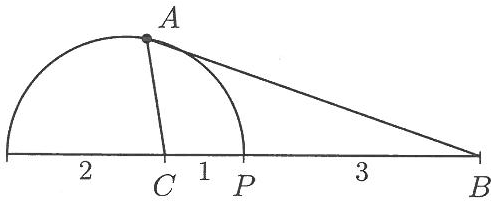
It is clear that the maximal height of the triangle, as measured from the base line of length , is , but that there is no minimal height. The area of the triangle may therefore take any positive value that is at most .