Balti Tee 2011 · Valikvooru ülesanne
Geomeetria
The side of a triangle is subdivided by the bisector of its opposite angle into two segments of lengths and . Determine all possible values of the area of that triangle.
Kui oled valmis
Ülevaatematerjal muutub kättesaadavaks järgmise päevaülesannete komplektiga.
Ülevaade
Teemad
Ringjooned ja puutujad · Geomeetrilised võrratused · Konstruktsioonid, geomeetrilised kohad, lõikumine ühes punktis ja kollineaarsus
Lahendused
Lahendus
Call the triangle and let be the angle bisector, with on , and . By the Angle Bisector Theorem, we get . Fixing the points and , the locus of all points satisfying this is an Apollonius circle, whose centre lies on the line . This circle passes through itself and a point on , that lies units beyond . Consequently that circle has radius .
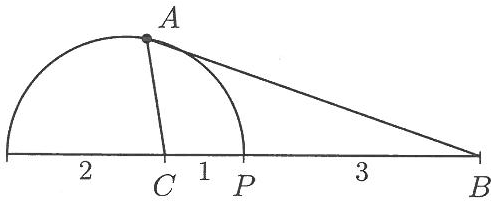
It is clear that the maximal height of the triangle, as measured from the base line of length , is , but that there is no minimal height. The area of the triangle may therefore take any positive value that is at most .