Baltic Way 2021 · Problem 11
Geometry
A point lies inside a triangle . The points and are the projections of onto and , respectively. The point lies on the line so that , and the point is symmetric to with respect to . Prove that .
When you’re ready
Review material becomes available with the next Daily.
Review
Topics
Triangles and centers · Transformations · Constructions, loci, concurrency and collinearity
Solutions
Solution
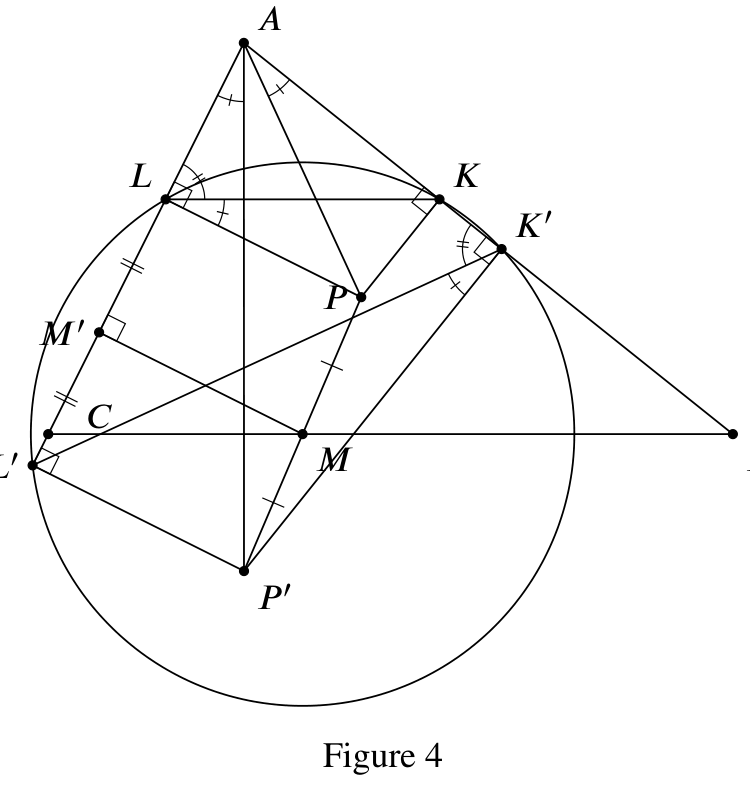
Figure 4
For points and let rot denote the rotation that takes rotates line to line modulo half turns. We consider two rotations equivalent one of them is a composition of some translation and the other rotation. It is clear that this is indeed an equivalence relation (as the Euclidean plane is Desarguean).
Let and be the projections of onto and respectively, as in figure 4 . Let be the perpendicular line to line passing through . From symmetries it follows that is the refection of over . In particular segments and are congruent. Similarly segments and are congruent. It follows that is a center of circle passing through and .
As line is perpendicular to line and line is perpendicular to line it follows that quadrilateral is cyclic. Similarly quadrilateral is also cyclic.
From the theorem on inscribed angles in cyclic quadrilaterals it follows that
As and are right it follows that modulo half turns. Now and
and so we decuce that .
Putting everything together gives
which gives the desired result.
Remark. This method can be applied to prove the existence of isogonal conjugates in triangles.
Contest context
Results from Baltic Way 2021
12 teams
- Mean score
- 3.0 / 5
- Scores of 4 or 5
- 7 / 12
- Estonia
- 5 / 5
Score distribution
All team scores
| Team | Score |
|---|---|
| St. Petersburg | 5 / 5 |
| Estonia | 5 / 5 |
| Germany | 0 / 5 |
| Latvia | 5 / 5 |
| Lithuania | 5 / 5 |
| Poland | 5 / 5 |
| Denmark | 5 / 5 |
| Norway | 5 / 5 |
| Finland | 0 / 5 |
| Sweden | 0 / 5 |
| Iceland | 0 / 5 |
| Ireland | 1 / 5 |