Baltic Way 1993 · Problem 19
Geometry
A convex quadrangle is inscribed in a circle with the centre . The angles and , taken in some order, are of the same size as the angles of quadrangle . Prove that is a square.
When you’re ready
Review material becomes available with the next Daily.
Review
Topics
Angles and distances · Cyclic geometry
Solutions
Solution
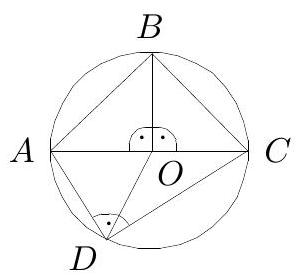 Figure 7
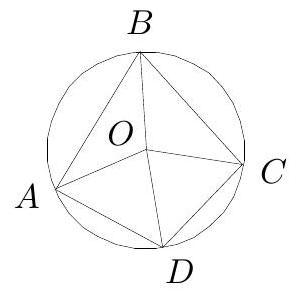 Figure 8
Solution:
As the quadrangle is inscribed in a circle, we have . It suffices to show that if each of these angles is equal to , then each of the angles and is also equal to and thus is a square. We consider the two possible situations:
(a) At least one of the diagonals of is a diameter — say, . Then and at least two of the angles and must be : say, . Now, and (see Figure 7). Using the fact that we have .
(b) None of the diagonals of the quadrangle is a diameter. Then and no angle of the quadrangle is equal to . Consequently, none of the angles and is equal to . Without loss of generality we assume that , (see Figure 8). Then and thus or . As , we have and , a contradiction.
Contest context
Results from Baltic Way 1993
8 teams
- Mean score
- 1.5 / 5
- Scores of 4 or 5
- 0 / 8
- Estonia
- 2 / 5
Score distribution
All team scores
| Team | Score |
|---|---|
| Poland | 0 / 5 |
| Latvia | 3 / 5 |
| Estonia | 2 / 5 |
| Sweden | 1 / 5 |
| Lithuania | 2 / 5 |
| Finland | 2 / 5 |
| Iceland | 0 / 5 |
| Denmark | 2 / 5 |