Balti Tee 1993 · Ülesanne 19
Geomeetria
A convex quadrangle is inscribed in a circle with the centre . The angles and , taken in some order, are of the same size as the angles of quadrangle . Prove that is a square.
Kui oled valmis
Ülevaatematerjal muutub kättesaadavaks järgmise päevaülesannete komplektiga.
Ülevaade
Teemad
Nurgad ja kaugused · Tsükliline geomeetria
Lahendused
Lahendus
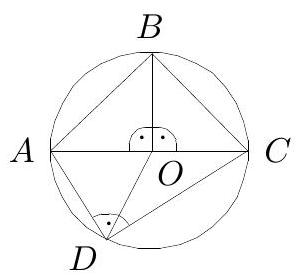 Figure 7
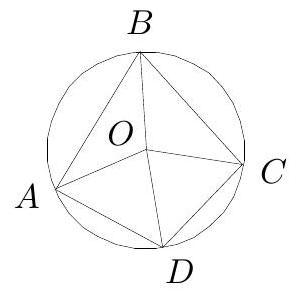 Figure 8
Solution:
As the quadrangle is inscribed in a circle, we have . It suffices to show that if each of these angles is equal to , then each of the angles and is also equal to and thus is a square. We consider the two possible situations:
(a) At least one of the diagonals of is a diameter — say, . Then and at least two of the angles and must be : say, . Now, and (see Figure 7). Using the fact that we have .
(b) None of the diagonals of the quadrangle is a diameter. Then and no angle of the quadrangle is equal to . Consequently, none of the angles and is equal to . Without loss of generality we assume that , (see Figure 8). Then and thus or . As , we have and , a contradiction.
Võistluse kontekst
Balti Tee tulemused 1993
8 võistkonda
- Keskmine tulemus
- 1,5 / 5
- 4 või 5 punkti
- 0 / 8
- Eesti
- 2 / 5
Punktijaotus
Kõigi võistkondade punktid
| Võistkond | Punktid |
|---|---|
| Poland | 0 / 5 |
| Latvia | 3 / 5 |
| Estonia | 2 / 5 |
| Sweden | 1 / 5 |
| Lithuania | 2 / 5 |
| Finland | 2 / 5 |
| Iceland | 0 / 5 |
| Denmark | 2 / 5 |