Balti Tee 1993 · Ülesanne 14
Kombinatoorika
A square is divided into 16 equal squares, obtaining the set of 25 different vertices. What is the least number of vertices one must remove from this set, so that no 4 points of the remaining set are the vertices of any square with sides parallel to the sides of the initial square?
Kui oled valmis
Ülevaatematerjal muutub kättesaadavaks järgmise päevaülesannete komplektiga.
Ülevaade
Teemad
Värvimised ja konfiguratsioonid · Dirichlet’ printsiip ja ekstremaalargumendid
Lahendused
Lahendus
Solution:
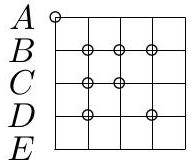
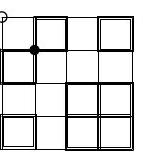
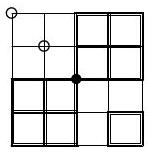
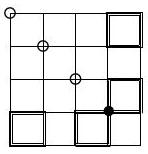
The example in Figure 3a demonstrates that it suffices to remove 8 vertices to "destroy" all squares. Assume now that we have managed to do that by removing only 6 vertices. Denote the horizontal and vertical lines by and respectively. Obviously, one of the removed vertices must be a vertex of the big square - let this be vertex . Then, in order to "destroy" all the squares shown in Figure we have to remove vertices and . Thus we have removed 6 vertices without having any choice but a square shown in Figure is still left intact.
 c
c
 d
d
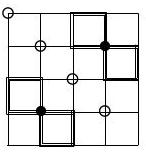 e
e
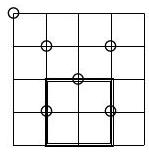 f
Figure 3
f
Figure 3
Võistluse kontekst
Balti Tee tulemused 1993
8 võistkonda
- Keskmine tulemus
- 0,9 / 5
- 4 või 5 punkti
- 0 / 8
- Eesti
- 1 / 5
Punktijaotus
Kõigi võistkondade punktid
| Võistkond | Punktid |
|---|---|
| Poland | 0 / 5 |
| Latvia | 0 / 5 |
| Estonia | 1 / 5 |
| Sweden | 2 / 5 |
| Lithuania | 1 / 5 |
| Finland | 1 / 5 |
| Iceland | 1 / 5 |
| Denmark | 1 / 5 |