Baltic Way 2021 · Shortlist problem
Combinatorics
A convex -gon is triangulated with triangulation of non-intersecting diagonals. An independent set of vertices is a set of vertices of where no two vertices are connected by a side or by a diagonal. Let be the number of ways to choose an independent set of vertices with respect to the triangulation . Prove that the minimum is achieved for a zig-zag triangulation.
When you’re ready
Review material becomes available with the next Daily.
Review
Topics
Colorings and configurations · Pigeonhole and extremal arguments · Induction and recursion
Solutions
Solution
- Let be the number of ways to choose an independent set of vertices for a zig-zag triangulation of an -gon. It is known that each triangulation has at least two vertices which are not the endpoints of any diagonal. Let be one of these vertices for the zig-zag triangulation (see figure above). If the independent set does not contain , then by removing the vertex we obtain a zig-zag triangulated -gon. If the independent set contains , then it does not contain its two neighbours, and by removing and its two neighbours we obtain a zig-zag triangulated -gon. Therefore satisfies the recurrence relation
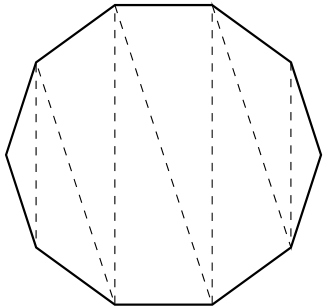 Figure 9: A zig-zag triangulation of a 10-gon.
-
We will consider a triangulation of -gon as a graph: the vertices of -gon are vertices of the graph, the sides and the diagonals are edges.
-
Now we will prove the problem statement by induction on . Base is trivial. Let the statement hold for all convex triangulations on less than vertices. Consider a triangulated -gon as a graph. The triangulation has at least two vertices of degree 2. Let be one of these vertices, be its neighbours. As in part 1), consider independent sets that do not contain . The number of these sets equals the number of independent sets in graph . By induction hypothesis it is at most . Now consider independent sets that contain (and do not contain and ). The number of these sets equals the number of independent sets in the graph which has vertices. But generally speaking, graph is not a graph of a triangulation. Let us add some edges to in order to obtain graph of some triangulation. This operation of adding new diagonals creates new neighbours in the graph, and thus decreases the number of independent sets. Then . Thus,