Baltic Way 2021 · Problem 7
Combinatorics
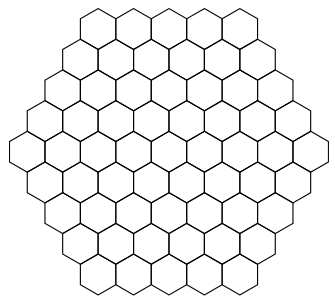
Let be an integer. Anna, Edda and Magni play a game on a hexagonal board tiled with regular hexagons, with tiles on each side. The figure shows a board with 5 tiles on each side. The central tile is marked. The game begins with a stone on a tile in one corner of the board. Edda and Magni are on the same team, playing against Anna, and they win if the stone is on the central tile at the end of any player's turn. Anna, Edda and Magni take turns moving the stone: Anna begins, then Edda and then Magni, and so on.
The rules for each player's turn are:
- Anna has to move the stone to an adjacent tile, in any direction.
- Edda has to move the stone straight by two tiles in any of the 6 possible directions.
- Magni has a choice of passing his turn, or moving the stone straight by three tiles in any of the 6 possible directions.
Find all for which Edda and Magni have a winning strategy.
When you’re ready
Review material becomes available with the next Daily.
Review
Topics
Colorings and configurations · Pigeonhole and extremal arguments · Games and strategies
Solutions
Solution
We colour the board in three colours in such a way that no neighbouring tiles are of the same colour. We can give each hexagon a coordinate using and as basis. Let the center square be the origin. Then each hexagon has center at , . The tuple is the coordinate for a given hexagon; its neighbours are , , , , and .
We colour the hexagon with coordinates with colour number . It is clear that neighbouring hexagons do not share a colour. (In fact this is the only three colouring of a hexagonal tiling). See figure 8.
We see that if , the token begins in a space in the same colour as the center hexagon, let that colour be grey. By regarding a few cases, we see that whatever Anne does, Ellie and Milo can end their turns by getting the token to a prescribed grey hexagon of the closest grey hexagons. Therefore they can get the token to the center.
If , the token does not begin on the same grey colour as the center. Say the stone begins on a white tile, and say the third colour is black. Anne can always move the stone to a grey hexagon that is not on the same horizontal/diagonal line as the center hexagon. Then Anne moves the stone to a white or black hexagon. After Milo moves the token is still again on a white/black hexagon. Anne can continue this indefinitely, with the token never reaching the center.
Contest context
Results from Baltic Way 2021
12 teams
- Mean score
- 3.8 / 5
- Scores of 4 or 5
- 10 / 12
- Estonia
- 4 / 5
Score distribution
All team scores
| Team | Score |
|---|---|
| St. Petersburg | 5 / 5 |
| Estonia | 4 / 5 |
| Germany | 4 / 5 |
| Latvia | 5 / 5 |
| Lithuania | 4 / 5 |
| Poland | 5 / 5 |
| Denmark | 5 / 5 |
| Norway | 4 / 5 |
| Finland | 0 / 5 |
| Sweden | 5 / 5 |
| Iceland | 1 / 5 |
| Ireland | 4 / 5 |