Baltic Way 2017 · Problem 8
Combinatorics
A chess knight has injured his leg and is limping. Its moves alternate between a normal chess-knight move and a short move to any diagonally adjacent cell. The knight moves on a chessboard, starting with a normal move. What is the largest number of moves it can make if it may choose its initial cell and may not visit any cell, including the initial cell, more than once?
When you’re ready
Review material becomes available with the next Daily.
Review
Topics
Games and strategies · Colorings and configurations · Pigeonhole and extremal arguments
Solutions
Solution
Answer: 25 moves.
Let us enumerate the rows of the chessboard with numbers 1 to 5 . We will consider only the short moves. Each short move connects two cells from rows of different parity and no two short moves has a common cell. Therefore there can be at most 12 short moves as there are just 12 cells in the rows of even parity (second and fourth). It means that the maximal number of moves is 12 short +13 normal moves.
The figure shows that 25 moves indeed can be made.
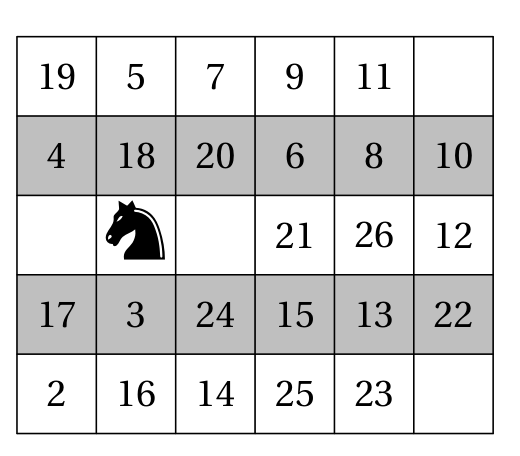
Official construction showing 25 moves.
Contest context
Results from Baltic Way 2017
11 teams
- Mean score
- 3.2 / 5
- Scores of 4 or 5
- 7 / 11
- Estonia
- 5 / 5
Score distribution
All team scores
| Team | Score |
|---|---|
| St. Petersburg | 4 / 5 |
| Germany | 4 / 5 |
| Poland | 5 / 5 |
| Denmark | 5 / 5 |
| Estonia | 5 / 5 |
| Lithuania | 1 / 5 |
| Sweden | 1 / 5 |
| Norway | 5 / 5 |
| Finland | 0 / 5 |
| Iceland | 4 / 5 |
| Latvia | 1 / 5 |