Baltic Way 2017 · Problem 6
Combinatorics
Fifteen stones are placed on a board, one in each cell, the remaining cell being empty. Whenever two stones are on neighbouring cells (having a common side), one may jump over the other to the opposite neighbouring cell, provided this cell is empty. The stone jumped over is removed from the board. For which initial positions of the empty cell is it possible to end up with exactly one stone on the board?
When you’re ready
Review material becomes available with the next Daily.
Review
Topics
Games and strategies · Colorings and configurations
Solutions
Solution
There are three types of cells on the board: corner cells, edge cells and centre cells. Colour the cells in three distinct colours as follows.
Suppose there are initially stones on cells of colours A, B, C, respectively. With each move, one of these numbers will increase by 1 , while the other two will decrease by 1 . Because there are fourteen moves altogether, the game must end with of the same parity as they originally had. There are cells of each colour on the board, so if the game should end with a single stone remaining, the game must begin with
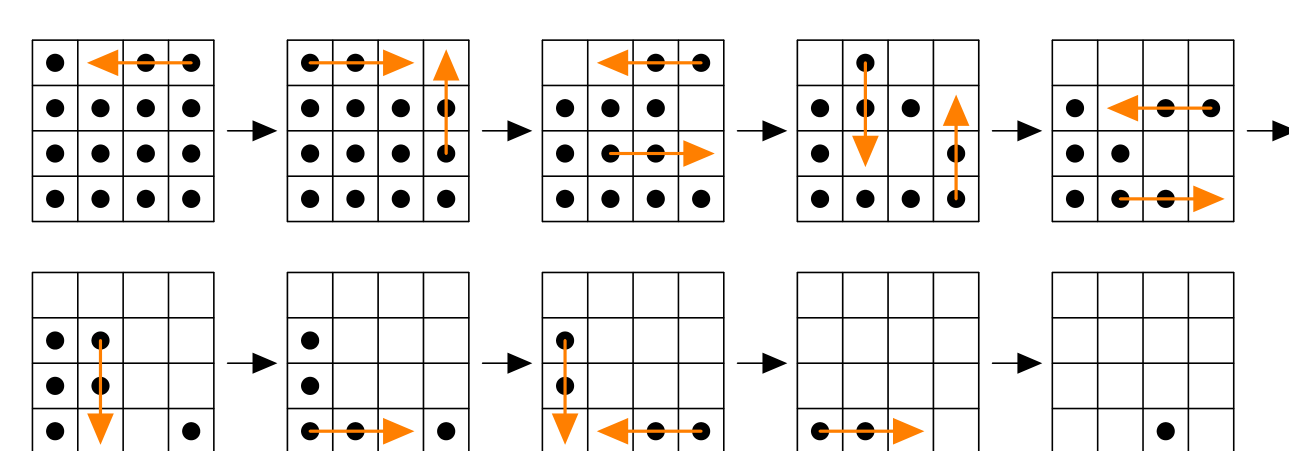
The empty slot should thus have colour B or C. This excludes the corner cells and two of the centre cells. However, by symmetry (changing the colouring), the two remaining centre cells will also be excluded. Hence the empty space at the beginning must be at an edge cell. That the game is indeed winnable in this case can be seen from the sequence of moves here:
Contest context
Results from Baltic Way 2017
11 teams
- Mean score
- 2.6 / 5
- Scores of 4 or 5
- 5 / 11
- Estonia
- 5 / 5
Score distribution
All team scores
| Team | Score |
|---|---|
| St. Petersburg | 5 / 5 |
| Germany | 1 / 5 |
| Poland | 5 / 5 |
| Denmark | 5 / 5 |
| Estonia | 5 / 5 |
| Lithuania | 0 / 5 |
| Sweden | 1 / 5 |
| Norway | 0 / 5 |
| Finland | 5 / 5 |
| Iceland | 1 / 5 |
| Latvia | 1 / 5 |