Baltic Way 1998 · Problem 13
Geometry
In a convex pentagon , the sides and are parallel and . The diagonals and intersect at . Prove that and .
When you’re ready
Review material becomes available with the next Daily.
Review
Topics
Angles and distances · Transformations
Solutions
Solution
Solution:
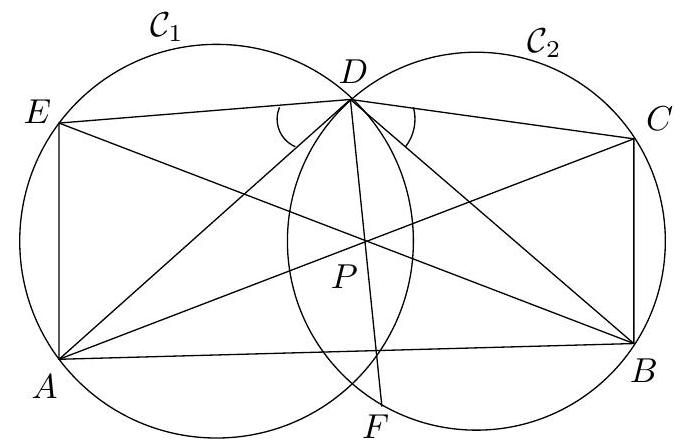 Figure 4
Let and be the circumcircles of triangles and , respectively. Let meet for the second time at (see Figure 4). Since , the ratio of the lengths of the segments and is equal to the ratio of the radii of and . Thus the homothety with centre that takes to , also transforms onto . The same homothety transforms the arc of onto the of . Therefore . The second equality is proved similarly.
Contest context
Results from Baltic Way 1998
11 teams
- Mean score
- 0.0 / 5
- Scores of 4 or 5
- 0 / 11
- Estonia
- 0 / 5
Score distribution
011
10
20
30
40
50
All team scores
| Team | Score |
|---|---|
| Latvia | 0 / 5 |
| Estonia | 0 / 5 |
| Poland | 0 / 5 |
| Finland | 0 / 5 |
| St. Petersburg | 0 / 5 |
| Sweden | 0 / 5 |
| Denmark | 0 / 5 |
| Iceland | 0 / 5 |
| Norway | 0 / 5 |
| Germany | 0 / 5 |
| Lithuania | 0 / 5 |