Baltic Way 1993 · Problem 17
Geometry
Let's consider three pairwise non-parallel straight lines in the plane. Three points are moving along these lines with different non-zero velocities, one on each line (we consider the movement as having taken place for infinite time and continuing infinitely in the future). Is it possible to determine these straight lines, the velocities of each moving point and their positions at some "zero" moment in such a way that the points never were, are or will be collinear?
When you’re ready
Review material becomes available with the next Daily.
Review
Topics
Coordinates and vectors · Constructions, loci, concurrency and collinearity · Transformations
Solutions
Solution
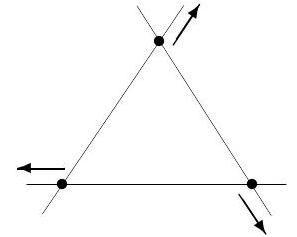 Figure 5
Solution: Yes, it is. First, place the three points at the vertices of an equilateral triangle at the "zero" moment and let them move with equal velocities along the straight lines determined by the sides of the triangle as shown in Figure 5. Then, at any moment in the past or future, the points are located at the vertices of some equilateral triangle, and thus cannot be collinear. Finally, to make the velocities of the points also differ, take any non-zero constant vector such that its projections on the three lines have different lengths and add it to each of the velocity vectors. This is equivalent to making the whole picture "drift" across the plane with constant velocity, so the non-collinearity of our points is preserved (in fact, they are still located at the vertices of an equilateral triangle at any given moment).
Contest context
Results from Baltic Way 1993
8 teams
- Mean score
- 2.0 / 5
- Scores of 4 or 5
- 3 / 8
- Estonia
- 5 / 5
Score distribution
All team scores
| Team | Score |
|---|---|
| Poland | 0 / 5 |
| Latvia | 5 / 5 |
| Estonia | 5 / 5 |
| Sweden | 0 / 5 |
| Lithuania | 0 / 5 |
| Finland | 4 / 5 |
| Iceland | 2 / 5 |
| Denmark | 0 / 5 |