Baltic Way 1990 · Problem 8
Geometry
Let be a point on the circumcircle of a triangle . It is known that the base points of the perpendiculars drawn from onto the lines and lie on one straight line (called a Simson line). Prove that the Simson lines of two diametrically opposite points and are perpendicular.
When you’re ready
Review material becomes available with the next Daily.
Review
Topics
Constructions, loci, concurrency and collinearity · Angles and distances · Cyclic geometry
Solutions
Solution
Solution:
Let be the circumcentre of the triangle and be its maximal angle (so that and are necessarily acute). Further, let and be the base points of the perpendiculars drawn from the point to the sides and respectively and let be the angle between the Simson line of point and the height of the triangle drawn to the side . It is sufficient to prove that . To show this, first note that the points all belong to a certain circle. Now we have to consider several sub-cases depending on the order of these points on that circle and the location of point on the circumcircle of triangle . Figure 2 shows one of these cases - here we have . The other cases can be treated in a similar manner.
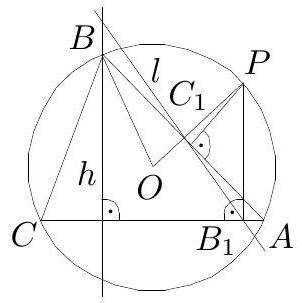 Figure 2