Päevaülesanne

Juhuslik

Harjutuskomplekt

Balti Tee 2021 · Valikvooru ülesanne

Geomeetria

Assume that ABCDABCD is a cyclic quadrilateral with circumcircle Ω\Omega. Assume lines ABAB and CDCD intersect at point PP and lines ADAD and BCBC intersect at QQ. Let Γ\Gamma be the circumcircle of triangle APQAPQ. Then Ω\Omega and Γ\Gamma intersect in two points, AA is one of them and RR is the other. Assume C≠RC \neq R. Prove that line CRCR passes through MM where MM is the midpoint of linesegment PQPQ.

Muuda valikut

Kui oled valmis

Ülevaatematerjal muutub kättesaadavaks järgmise päevaülesannete komplektiga.

Ülevaade

Teemad

Tsükliline geomeetria · Nurgad ja kaugused · Teisendused

Lahendused

Lahendus 1

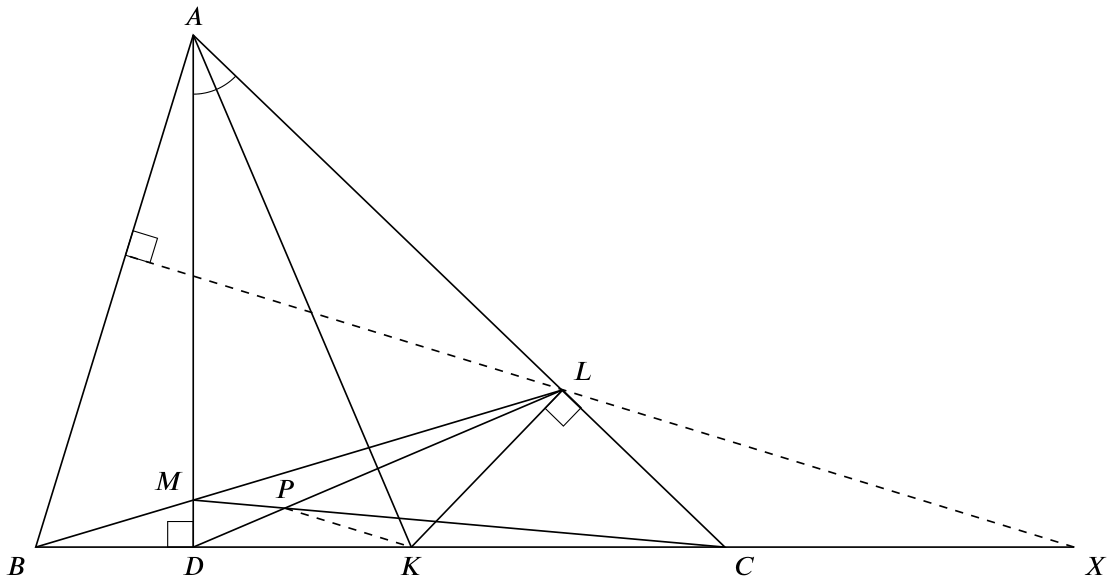
Solution 1. Let XX be a point on BCBC such that LX⊥ABLX \perp AB, as seen in figure 18. It is enough to prove that

DPPL=DKKX\frac{DP}{PL} = \frac{DK}{KX}

because then PK∥LXPK \parallel LX and LX⊥ABLX \perp AB. Applying Menelaos for triangle BDL and transversal MPC we get

DPPL⋅LMMB⋅BCCD=1,\frac{DP}{PL} \cdot \frac{LM}{MB} \cdot \frac{BC}{CD} = 1,

and Menelaus for triangle BLC and transversal AMD gives

BMML⋅LAAC⋅CDDB=1.\frac{BM}{ML} \cdot \frac{LA}{AC} \cdot \frac{CD}{DB} = 1.

Multiplying these two equalities yields

DP⋅BC⋅ALPL⋅BD⋅AC=1.\frac{DP \cdot BC \cdot AL}{PL \cdot BD \cdot AC} = 1.

Note, however, that AL=AD=ACsin⁡γAL = AD = AC \sin \gamma, BD=ABcos⁡βBD = AB \cos \beta, and, by the sine rule, ABBC=sin⁡γsin⁡α\frac{AB}{BC} = \frac{\sin \gamma}{\sin \alpha}, where α=∠BAC\alpha = \angle BAC, β=∠CBA\beta = \angle CBA and γ=∠ACB\gamma = \angle ACB. Therefore

DPPL=BD⋅ACBC⋅AL=ABcos⁡β⋅ACBC⋅ACsin⁡γ=sin⁡γcos⁡βsin⁡αsin⁡γ=cos⁡βsin⁡α.\frac{DP}{PL} = \frac{BD \cdot AC}{BC \cdot AL} = \frac{AB \cos \beta \cdot AC}{BC \cdot AC \sin \gamma} = \frac{\sin \gamma \cos \beta}{\sin \alpha \sin \gamma} = \frac{\cos \beta}{\sin \alpha}.

On the other hand, since DK=KLDK = KL, ∠KLX=π−α\angle KLX = \pi - \alpha, and ∠LXX=π2−β\angle LXX = \frac{\pi}{2} - \beta, we have by the sine rule Diagram for the mathnet 01i6 1 of bw-cand-2021-mn-01i6.

Therefore

DPPL=cos⁡βsin⁡α=DKKX\frac{DP}{PL} = \frac{\cos \beta}{\sin \alpha} = \frac{DK}{KX}
Lahendus 2

Solution 2. Let ω\omega be the circle with center KK an radius KDKD, as in figure 19. Then ω\omega is tangent to ADAD and ALAL. Let BCBC intersect ω\omega at DD and QQ. Let BMBM intersect ω\omega at LL and RR. Let QPQP intersect BLBL at SS. Cross-ratio chasing gives, through the projections BL→DBL \to D-pencil →ω→L\to \omega \to L-pencil →BC→P\to BC \to P-pencil →BL\to BL,

(L,R;M,B)=(DL,DR;DM,DB)=(L,R;D,Q)=(LC,LB;LD,LQ)=(C,B;D,Q)=(PC,PB;PD,PQ)=(M,B;L,S)=(L,S;M,B),\begin{aligned} (L, R; M, B) &= (DL, DR; DM, DB) = (L, R; D, Q) = (LC, LB; LD, LQ) \\ &= (C, B; D, Q) = (PC, PB; PD, PQ) = (M, B; L, S) = (L, S; M, B), \end{aligned}

therefore R=SR = S. It is clear now that PP lies on the polar lines of both AA and BB with respect to ω\omega, therefore ABAB is the polar line of PP. This implies that PK⊥ABPK \perp AB.