Balti Tee 2021 · Valikvooru ülesanne
Geomeetria
Given an equilateral triangle, find all positive integers such that it can be partitioned into equilateral triangles (not necessarily of the same size).
Kui oled valmis
Ülevaatematerjal muutub kättesaadavaks järgmise päevaülesannete komplektiga.
Ülevaade
Teemad
Konstruktsioonid, geomeetrilised kohad, lõikumine ühes punktis ja kollineaarsus · Kolmnurgad ja märkimisväärsed punktid
Lahendused
Lahendus
An equilateral triangle can be partitioned into one piece, that is a partition with the triangle itself as the only piece. We also note that the cases and are possible as figure 5 shows
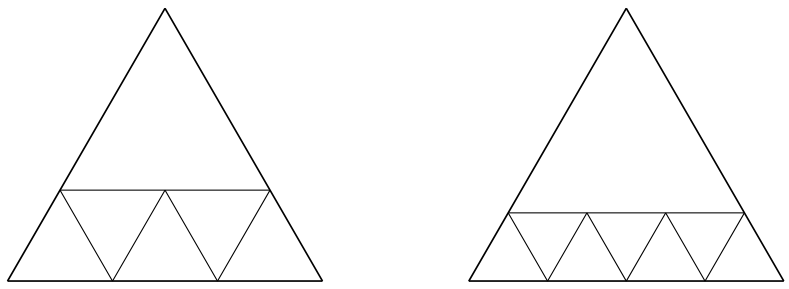 Figure 5: The cases and
Assume that the original triangle can be partitioned into equilateral triangles. Partition the equilateral triangle into four parts as depicted in figure 6. Then partition one of the resulting equilateral triangles into parts. We have therefore partitioned the equilateral triangle into parts. As the equilateral triangle can be partitioned into 1 part, it follows that the triangle can be partitioned into equilateral triangles if for some . Similarly, the constructions for and show that the triangle can be partitioned into parts and parts for any .
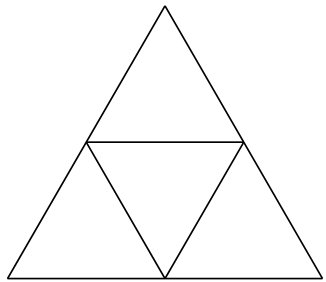 Figure 6: Partition of an equilateral triangle into four equilateral triangles
We have therefore shown that the equilateral triangle can be partitioned into equilateral triangles for all except . We proceed to show that the equilateral triangle can not be partitioned into equilateral triangles if . Consider the cases: (i) Assume that . By the pigeonhole principle, one triangle shares two vertices with the original triangle, and will therefore be the entire triangle. This is absurd, so no partition for is possible. (ii) Assume that . As in the case above, no triangle shares two vertices with the original triangle. So each triangle shares exactly one vertex with the original triangle. In each of the 3 smaller triangles, let , be the side opposing the vertex common with the original triangle. The side lies inside the triangle, so it must be a side of two smaller triangles. However, the only internal segments of the other triangles are and , but can only coincide with either or . We conclude that no partition is possible for . (iii) Assume that . As above, no triangle shares two vertices with the original triangle. Consider the three triangles that share a vertex with the original triangle, and the sides as above. As this is a partition, we know the 's intersect either on the sides of the large triangle or outside it. We get four cases depending on how they intersect.
- If all three pairs intersect outside of the original triangle, the remaining shape is a convex hexagon.
- If two pairs intersect outside of the original triangle, and one pair on a side of the triangle, we get a convex pentagon.
- If two pairs intersect on the sides of the triangle, and one pair on the side of the triangle, we get an isosceles trapezoid.
- If all pairs intersect on the sides of the triangle, we get an equilateral triangle We are to split the remaining convex shape, a hexagon, a pentagon, an isosceles trapezoid, or a triangle, into two triangles. The only convex shape split up into two equilateral triangles is the rhombus with one angle of 60°. We conclude that no partition is possible for . We have shown that the equilateral triangle can be partitioned into parts for all positive integers except .