Balti Tee 2024 · Ülesanne 15
Geomeetria
There is a set of points in the plane, such that no three of them are collinear. Three points , in the set are said to form a Baltic triangle if no other point in the set lies on the circumcircle of triangle . Assume that there exists at least one Baltic triangle. Show that there exist at least Baltic triangles.
Kui oled valmis
Ülevaatematerjal muutub kättesaadavaks järgmise päevaülesannete komplektiga.
Ülevaade
Teemad
Ringjooned ja puutujad · Tsükliline geomeetria · Kolmnurgad ja märkimisväärsed punktid
Lahendused
Lahendus
If , the number of Baltic triangles is 1 which is .
To show that there always exist at least Baltic triangles, we prove that every point is a vertex of at least one Baltic triangle. This implies the desired result because every Baltic triangle consists of exactly 3 points.
First we prove a useful lemma: Given points in the plane, either all are collinear or there exists a line passing through exactly 2 points.
Proof: Take a line going through at least 2 points, and a point not on the line such that the distance from to is minimal over all such pairs. Denote as the projection of to . If contains at least 3 points, two of them must be on the same side of (or coincide with ). Say those points are and , with lying between and (Fig. 18). But then the distance from to the line is smaller than and this contradicts minimality.
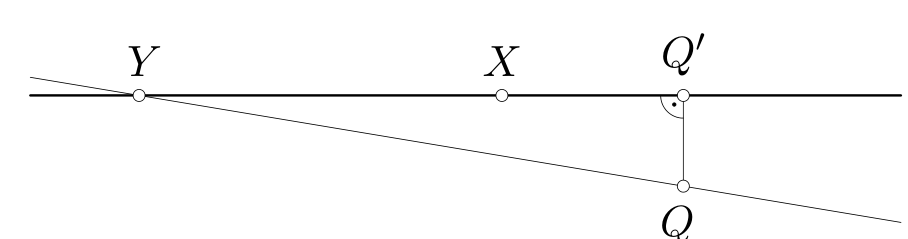
Figure 18 Now assume and apply an inversion of the plane with center where is any point in the given set. Consider the other points after the inversion. By our lemma, there exists a line going through exactly 2 of them, because if they were all collinear, all points would have been concyclic before the inversion, contradicting the assumption about the existence of a Baltic triangle. Denote these points as and . The line cannot go through , because this would mean that these 3 points were collinear before the inversion. But then before the inversion, no other point lied on the circumcircle of triangle , meaning that formed a Baltic triangle. So every single point in the given set is a vertex of at least one Baltic triangle and we are done. Remark: The lemma proved in the solution is known as the Sylvester-Gallai theorem.
Võistluse kontekst
Balti Tee tulemused 2024
11 võistkonda
- Keskmine tulemus
- 0,3 / 5
- 4 või 5 punkti
- 0 / 11
- Eesti
- 3 / 5
Punktijaotus
Kõigi võistkondade punktid
| Võistkond | Punktid |
|---|---|
| Poland | 0 / 5 |
| Estonia | 3 / 5 |
| Germany | 0 / 5 |
| Ukraine | 0 / 5 |
| Latvia | 0 / 5 |
| Norway | 0 / 5 |
| Lithuania | 0 / 5 |
| Sweden | 0 / 5 |
| Denmark | 0 / 5 |
| Finland | 0 / 5 |
| Iceland | 0 / 5 |