Balti Tee 2024 · Ülesanne 10
Kombinatoorika
A frog is located on a unit square of an infinite grid oriented according to the cardinal directions. The frog makes moves consisting of jumping either one or two squares in the direction it is facing, and then turning according to the following rules: (i) If the frog jumps one square, it then turns to the right; (ii) If the frog jumps two squares, it then turns to the left.
Is it possible for the frog to reach the square exactly 2024 squares north of the initial square after some finite number of moves if it is initially facing: (a) North; (b) East?
Kui oled valmis
Ülevaatematerjal muutub kättesaadavaks järgmise päevaülesannete komplektiga.
Ülevaade
Teemad
Mängud ja strateegiad
Lahendused
Lahendus 1
(a) We color the grid with 5 colors so that the color of a square is determined by the expression modulo 5 , where are the coordinates of the square (we assume that the side length of the square is 1 ; see Fig. 9). Without loss of generality, let the color of the target square be 0 , and let the frog be there facing in the positive -direction. Before the move that brought the frog to this position, it must have been either on a square of color 1 , facing in the positive direction, or on a square of color 2 , facing in the negative -direction. In either case, one move earlier, the frog must have been either on a square of color 3 , facing in the negative -direction, or on a square of color 0 , facing in the positive -direction. If at some point the frog was on a square of color 3 , facing in the negative -direction, then before the move that brought it there, it must have been either on a square of color 1 , facing in the positive -direction, or on a square of color 2 , facing in the negative -direction. This exhausts all possible cases, showing that throughout the entire process, the frog could only be in one of the following four positions:
- On a square of color 0 , facing in the positive -direction;
- On a square of color 1 , facing in the positive -direction;
- On a square of color 2 , facing in the negative -direction;
- On a square of color 3 , facing in the negative -direction.
Based on this, we examine all possibilities:
| 0 | 2 | 4 | 1 | 3 | 0 | 2 | 4 | 1 | 3 | 0 | ||
| 4 | 1 | 3 | 0 | 2 | 4 | 1 | 3 | 0 | 2 | 4 | ||
| 3 | 0 | 2 | 4 | 1 | 3 | 0 | 2 | 4 | 1 | 3 | ||
| 2 | 4 | 1 | 3 | 0 | 2 | 4 | 1 | 3 | 0 | 2 | ||
| 1 | 3 | 0 | 2 | 4 | 1 | 3 | 0 | 2 | 4 | 1 | ||
| 0 | 2 | 4 | 1 | 3 | 0 | 2 | 4 | 1 | 3 | 0 | ||
| 4 | 1 | 3 | 0 | 2 | 4 | 1 | 3 | 0 | 2 | 4 | ||
| 3 | 0 | 2 | 4 | 1 | 3 | 0 | 2 | 4 | 1 | 3 | ||
| 2 | 4 | 1 | 3 | 0 | 2 | 4 | 1 | 3 | 0 | 2 | ||
| 1 | 3 | 0 | 2 | 4 | 1 | 3 | 0 | 2 | 4 | 1 | ||
| 0 | 2 | 4 | 1 | 3 | 0 | 2 | 4 | 1 | 3 | 0 | ||
Figure 9
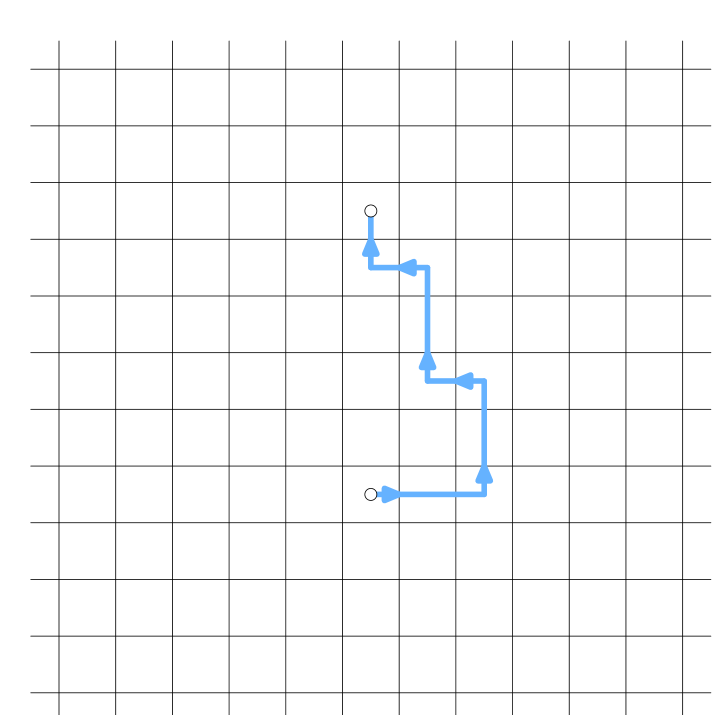
Figure 10
- If the positive -direction corresponds to north, then the color of the initial square is 1 , and the frog must have been facing in the positive -direction, that is, east.
- If the positive -direction corresponds to east, then the color of the initial square is 3 , and the frog must have been facing in the negative -direction, that is, west.
- If the positive -direction corresponds to west, then the color of the initial square is 2 , and the frog must have been facing in the negative -direction, that is, south.
- If the positive -direction corresponds to south, then the color of the initial square is 4 , from which the frog could not reach the target square at all. This demonstrates that if the frog reaches the target square, it cannot have been facing north at the initial square. (b) Let the frog at some point face east. Then it can make the following moves: east 2 squares, north 2 squares, west 1 square, north 2 squares, west 1 square, north 1 square (Fig. 10). This way, the frog has moved a total of 5 squares north, and after these moves, it is again facing east. Therefore, by repeating this sequence of moves 405 times, the frog can reach a point 2025 squares north of the initial square. By omitting the last move, the frog reaches exactly the square that is 2024 squares north of the initial square.
Remark: Similarly to the solution of part (b), one can show that the frog can reach the desired square also after making its first move to the south or to the west.
Let be a cyclic quadrilateral with circumcentre and with perpendicular to . Points and lie on the circumcircle of the triangle such that . Let be the midpoint of . Prove that is tangent to the circumcircle of the triangle .
Lahendus 2
Denote the circumradius of by and the circumcircle of triangle by . Let , let meet again at , and let be a diameter of (Fig. 11). We see that as and . Furthermore, note that
so is tangent to the circumcircle of the triangle and thus .
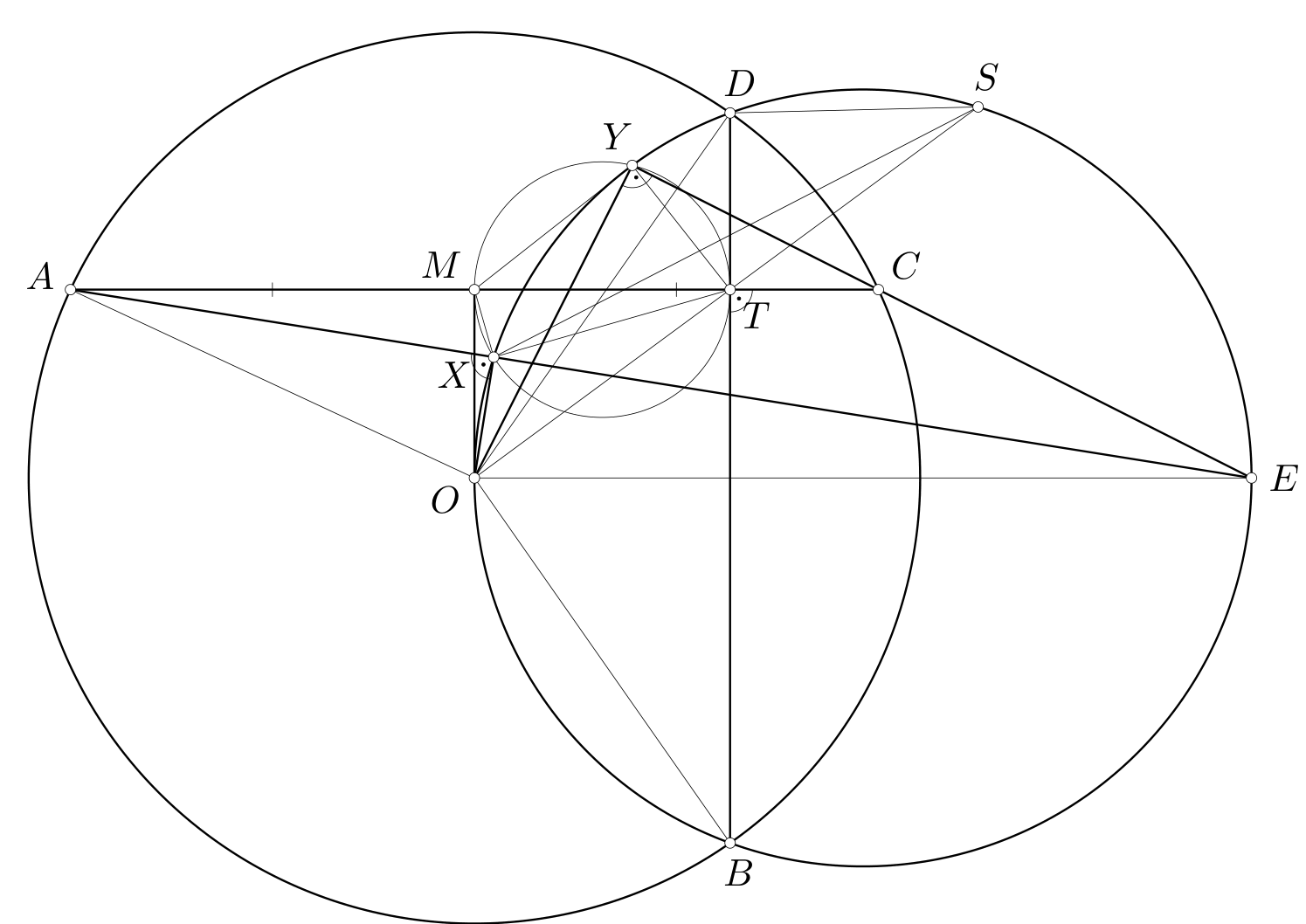
Figure 11
We find so are collinear. Since also , points , are concyclic. Next, we can see that points are concyclic since . Moreover, is tangent to this circle as . Hence , so is tangent to the circumcircle of triangle at . By interchanging the roles of and and the roles of and , we can similarly prove that is also tangent to the circumcircle of triangle at . But then these two circles must coincide. Now implies that is a diameter of this one circle, and implies that is tangent to it. The desired result follows.
Võistluse kontekst
Balti Tee tulemused 2024
11 võistkonda
- Keskmine tulemus
- 4,2 / 5
- 4 või 5 punkti
- 9 / 11
- Eesti
- 5 / 5
Punktijaotus
Kõigi võistkondade punktid
| Võistkond | Punktid |
|---|---|
| Poland | 5 / 5 |
| Estonia | 5 / 5 |
| Germany | 5 / 5 |
| Ukraine | 5 / 5 |
| Latvia | 0 / 5 |
| Norway | 5 / 5 |
| Lithuania | 5 / 5 |
| Sweden | 5 / 5 |
| Denmark | 5 / 5 |
| Finland | 1 / 5 |
| Iceland | 5 / 5 |