Balti Tee 2023 · Ülesanne 6
Kombinatoorika
Let be a positive integer. Each cell of an table is coloured in one of colours where every colour is used at least once. Two different colours and are said to touch each other, if there exists a cell coloured in sharing a side with a cell coloured in . The table is coloured in such a way that each colour touches at most 2 other colours. What is the maximal value of in terms of ?
Kui oled valmis
Ülevaatematerjal muutub kättesaadavaks järgmise päevaülesannete komplektiga.
Ülevaade
Teemad
Värvimised ja konfiguratsioonid · Dirichlet’ printsiip ja ekstremaalargumendid · Graafiteooria
Lahendused
Lahendus
when and when .
is possible by colouring diagonally as shown in the figure below and when , is possible by colouring each cell in a unique colour.
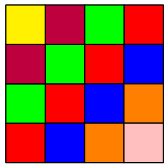
We consider the graph, where each node represents a colour and two nodes are linked, if the colours they represent touch. This graph is connected and since each colour touches at most 2 colours every node has at most degree 2. This means that the graph is either one long chain or one big cycle.
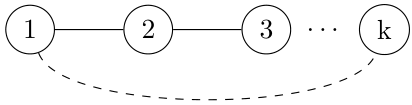
We now look at the case when is odd. Consider the cell in the center of the table. From this cell we can get to any other cell by passing through at most cells. Therefore from the node representing this cell, we can get to any node through at most edges. But if the graph has or more nodes, then for every node there is a node which is more than edges away. So we must have for all odd .
When is even we consider the 4 center cells. If they all have a different colour, then they form a 4-cycle in the graph, meaning the graph has only 4 nodes. If two of the center cells have the same colour, then from this colour you will be able to get to all other cells passing through at most cells. By same the arguments as in the odd case, we get for even .
So overall we have for and for as desired.
Võistluse kontekst
Balti Tee tulemused 2023
10 võistkonda
- Keskmine tulemus
- 2,4 / 5
- 4 või 5 punkti
- 3 / 10
- Eesti
- 4 / 5
Punktijaotus
Kõigi võistkondade punktid
| Võistkond | Punktid |
|---|---|
| Germany | 5 / 5 |
| Sweden | 2 / 5 |
| Lithuania | 4 / 5 |
| Poland | 2 / 5 |
| Estonia | 4 / 5 |
| Latvia | 2 / 5 |
| Norway | 2 / 5 |
| Denmark | 0 / 5 |
| Finland | 1 / 5 |
| Iceland | 2 / 5 |