Solution:
Let f ( t ) = 1 + t 2 f(t)=\sqrt{1+t^{2}} f ( t ) = 1 + t 2 f ′ ′ ( t ) = ( 1 + t 2 ) − 3 / 2 > 0 f''(t)=\left(1+t^{2}\right)^{-3 / 2}>0 f ′′ ( t ) = ( 1 + t 2 ) − 3/2 > 0 f ( t ) f(t) f ( t ) ( 0 , ∞ ) (0, \infty) ( 0 , ∞ )
1 cos γ = 1 + tan 2 γ = f ( tan γ ) = f ( tan α + tan β 2 ) < < f ( tan α ) + f ( tan β ) 2 = 1 2 ( 1 cos α + 1 cos β ) = 1 cos δ , \begin{aligned}
\frac{1}{\cos \gamma} & =\sqrt{1+\tan ^{2} \gamma}=f(\tan \gamma)=f\left(\frac{\tan \alpha+\tan \beta}{2}\right)< \\
& <\frac{f(\tan \alpha)+f(\tan \beta)}{2}=\frac{1}{2}\left(\frac{1}{\cos \alpha}+\frac{1}{\cos \beta}\right)=\frac{1}{\cos \delta},
\end{aligned} cos γ 1 = 1 + tan 2 γ = f ( tan γ ) = f ( 2 tan α + tan β ) < < 2 f ( tan α ) + f ( tan β ) = 2 1 ( cos α 1 + cos β 1 ) = cos δ 1 , and hence γ < δ \gamma<\delta γ < δ
Alternative solution. Draw a unit segment O P O P O P A A A B B B O P O P O P ∠ P O A = ∠ P O B = 90 ∘ \angle P O A=\angle P O B=90^{\circ} ∠ P O A = ∠ P O B = 9 0 ∘ ∠ O P A = α \angle O P A=\alpha ∠ O P A = α ∠ O P B = β \angle O P B=\beta ∠ O P B = β ∣ O A ∣ = tan α |O A|=\tan \alpha ∣ O A ∣ = tan α ∣ O B ∣ = tan β , ∣ P A ∣ = 1 cos α |O B|=\tan \beta,|P A|=\frac{1}{\cos \alpha} ∣ O B ∣ = tan β , ∣ P A ∣ = c o s α 1 ∣ P B ∣ = 1 cos β |P B|=\frac{1}{\cos \beta} ∣ P B ∣ = c o s β 1 C C C A B A B A B ∣ O C ∣ = tan α + tan β 2 = tan γ |O C|=\frac{\tan \alpha+\tan \beta}{2}=\tan \gamma ∣ O C ∣ = 2 t a n α + t a n β = tan γ ∠ O P C = γ \angle O P C=\gamma ∠ O P C = γ ∣ P C ∣ = 1 cos γ |P C|=\frac{1}{\cos \gamma} ∣ P C ∣ = c o s γ 1 Q Q Q P P P C C C P A Q B P A Q B P A QB ∣ A Q ∣ = ∣ P B ∣ = 1 cos β |A Q|=|P B|=\frac{1}{\cos \beta} ∣ A Q ∣ = ∣ P B ∣ = c o s β 1
2 cos δ = 1 cos α + 1 cos β = ∣ P A ∣ + ∣ A Q ∣ > ∣ P Q ∣ = 2 ⋅ ∣ P C ∣ = 2 cos γ , \frac{2}{\cos \delta}=\frac{1}{\cos \alpha}+\frac{1}{\cos \beta}=|P A|+|A Q|>|P Q|=2 \cdot|P C|=\frac{2}{\cos \gamma}, cos δ 2 = cos α 1 + cos β 1 = ∣ P A ∣ + ∣ A Q ∣ > ∣ P Q ∣ = 2 ⋅ ∣ P C ∣ = cos γ 2 , and hence δ > γ \delta>\gamma δ > γ
Another solution. Set x = α + β 2 x=\frac{\alpha+\beta}{2} x = 2 α + β y = α − β 2 y=\frac{\alpha-\beta}{2} y = 2 α − β α = x + y , β = x − y \alpha=x+y, \beta=x-y α = x + y , β = x − y
cos α cos β = 1 2 ( cos 2 x + cos 2 y ) = = 1 2 ( 1 − 2 sin 2 x ) + 1 2 ( 2 cos 2 y − 1 ) = cos 2 y − sin 2 x . \begin{aligned}
\cos \alpha \cos \beta & =\frac{1}{2}(\cos 2 x+\cos 2 y)= \\
& =\frac{1}{2}\left(1-2 \sin ^{2} x\right)+\frac{1}{2}\left(2 \cos ^{2} y-1\right)=\cos ^{2} y-\sin ^{2} x .
\end{aligned} cos α cos β = 2 1 ( cos 2 x + cos 2 y ) = = 2 1 ( 1 − 2 sin 2 x ) + 2 1 ( 2 cos 2 y − 1 ) = cos 2 y − sin 2 x . By the conditions of the problem,
tan γ = 1 2 ( sin α cos α + sin β cos β ) = 1 2 ⋅ sin ( α + β ) cos α cos β = sin x cos x cos α cos β \tan \gamma=\frac{1}{2}\left(\frac{\sin \alpha}{\cos \alpha}+\frac{\sin \beta}{\cos \beta}\right)=\frac{1}{2} \cdot \frac{\sin (\alpha+\beta)}{\cos \alpha \cos \beta}=\frac{\sin x \cos x}{\cos \alpha \cos \beta} tan γ = 2 1 ( cos α sin α + cos β sin β ) = 2 1 ⋅ cos α cos β sin ( α + β ) = cos α cos β sin x cos x and
1 cos δ = 1 2 ( 1 cos α + 1 cos β ) = 1 2 ⋅ cos α + cos β cos α cos β = cos x cos y cos α cos β . \frac{1}{\cos \delta}=\frac{1}{2}\left(\frac{1}{\cos \alpha}+\frac{1}{\cos \beta}\right)=\frac{1}{2} \cdot \frac{\cos \alpha+\cos \beta}{\cos \alpha \cos \beta}=\frac{\cos x \cos y}{\cos \alpha \cos \beta} . cos δ 1 = 2 1 ( cos α 1 + cos β 1 ) = 2 1 ⋅ cos α cos β cos α + cos β = cos α cos β cos x cos y . Using (3) we hence obtain
tan 2 δ − tan 2 γ = 1 cos 2 δ − 1 − tan 2 γ = cos 2 x cos 2 y − sin 2 x cos 2 x cos 2 α cos 2 β − 1 = = cos 2 x ( cos 2 y − sin 2 x ) ( cos 2 y − sin 2 x ) 2 − 1 = cos 2 x cos 2 y − sin 2 x − 1 = = cos 2 x − cos 2 y + sin 2 x cos 2 y − sin 2 x = sin 2 y cos α cos β > 0 , \begin{aligned}
\tan ^{2} \delta-\tan ^{2} \gamma & =\frac{1}{\cos ^{2} \delta}-1-\tan ^{2} \gamma=\frac{\cos ^{2} x \cos ^{2} y-\sin ^{2} x \cos ^{2} x}{\cos ^{2} \alpha \cos ^{2} \beta}-1= \\
& =\frac{\cos ^{2} x\left(\cos ^{2} y-\sin ^{2} x\right)}{\left(\cos ^{2} y-\sin ^{2} x\right)^{2}}-1=\frac{\cos ^{2} x}{\cos ^{2} y-\sin ^{2} x}-1= \\
& =\frac{\cos ^{2} x-\cos ^{2} y+\sin ^{2} x}{\cos ^{2} y-\sin ^{2} x}=\frac{\sin ^{2} y}{\cos \alpha \cos \beta}>0,
\end{aligned} tan 2 δ − tan 2 γ = cos 2 δ 1 − 1 − tan 2 γ = cos 2 α cos 2 β cos 2 x cos 2 y − sin 2 x cos 2 x − 1 = = ( cos 2 y − sin 2 x ) 2 cos 2 x ( cos 2 y − sin 2 x ) − 1 = cos 2 y − sin 2 x cos 2 x − 1 = = cos 2 y − sin 2 x cos 2 x − cos 2 y + sin 2 x = cos α cos β sin 2 y > 0 , showing that δ > γ \delta>\gamma δ > γ
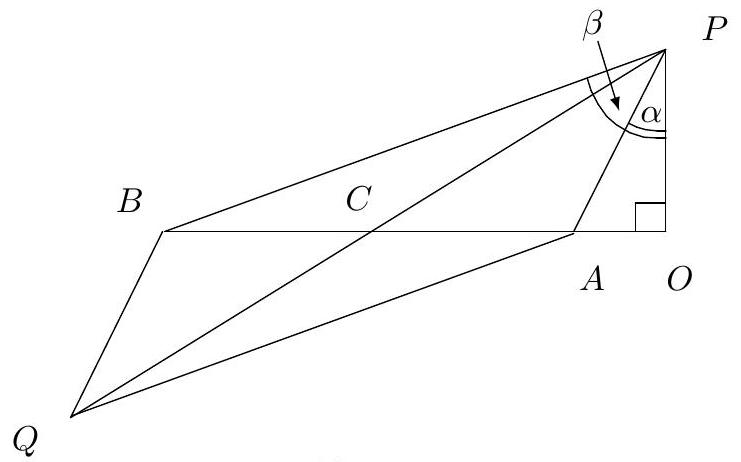 Figure 1
Let be the midpoint of the segment . By hypothesis, we have , hence and . Let be the point symmetric to with respect to . The quadrilateral is a parallelogram, and therefore . Eventually,
Figure 1
Let be the midpoint of the segment . By hypothesis, we have , hence and . Let be the point symmetric to with respect to . The quadrilateral is a parallelogram, and therefore . Eventually,