Balti Tee 1998 · Ülesanne 11
Geomeetria
Let and be the lengths of the sides of a triangle with circumradius . Prove that
When does equality hold?
Kui oled valmis
Ülevaatematerjal muutub kättesaadavaks järgmise päevaülesannete komplektiga.
Ülevaade
Teemad
Kolmnurgad ja märkimisväärsed punktid
Lahendused
Lahendus
Answer: equality holds if or the angle opposite to is equal to . Denote the angles opposite to the sides by , respectively. By the law of sines we have . Hence, the given inequality is equivalent to each of the following:
The last inequality follows from the Cauchy-Schwarz inequality:
Equality requires that and for a certain real number , implying that is positive and are acute angles. From these two equations we conclude that . This means that either or ; in other words, or . In each of these two cases the inequality indeed turns into equality.
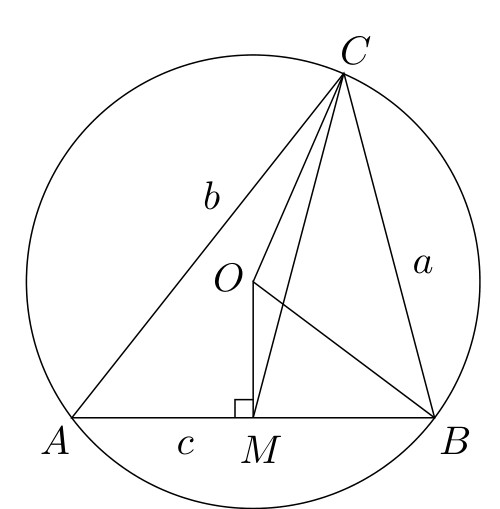
Figure 2
Alternative solution. Let be the respective vertices of the triangle, be its circumcentre and be the midpoint of (see Figure 2). The length of the median drawn from is expressed by the well- known formula
Hence the inequality of the problem can be rewritten as , or . The last inequality is equivalent to
or ||, which is the triangle inequality for triangle COM .
Equality holds if and only if the points are collinear. This happens if and only if or .
Remark. Yet another solution can be obtained by setting (where denotes the area of the triangle) and expressing by Heron's formula. After squaring both sides, cross-multiplying and cancelling a lot, the inequality reduces to , with equality if or .
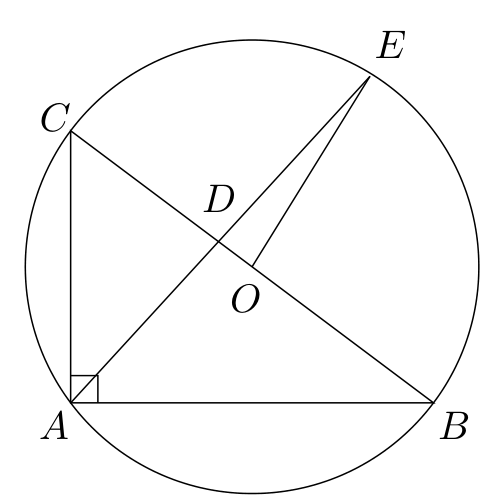
Figure 3
Võistluse kontekst
Balti Tee tulemused 1998
11 võistkonda
- Keskmine tulemus
- 0,8 / 5
- 4 või 5 punkti
- 2 / 11
- Eesti
- 4 / 5
Punktijaotus
Kõigi võistkondade punktid
| Võistkond | Punktid |
|---|---|
| Latvia | 0 / 5 |
| Estonia | 4 / 5 |
| Poland | 0 / 5 |
| Finland | 0 / 5 |
| St. Petersburg | 0 / 5 |
| Sweden | 4 / 5 |
| Denmark | 0 / 5 |
| Iceland | 0 / 5 |
| Norway | 1 / 5 |
| Germany | 0 / 5 |
| Lithuania | 0 / 5 |