Balti Tee 1997 · Ülesanne 13
Geomeetria
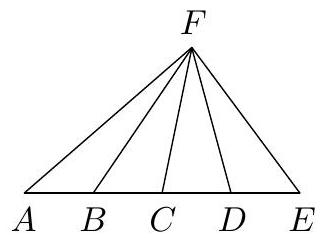
Five distinct points and lie on a line with
The point lies outside the line. Let be the circumcentre of triangle and be the circumcentre of triangle . Show that lines and are perpendicular.
Kui oled valmis
Ülevaatematerjal muutub kättesaadavaks järgmise päevaülesannete komplektiga.
Ülevaade
Teemad
Koordinaadid ja vektorid · Tsükliline geomeetria · Kolmnurgad ja märkimisväärsed punktid
Lahendused
Lahendus
Solution:
Let be the circumcentres of the triangles , and , respectively (see Figure 6). Then and lie on the perpendicular bisector of the segment , while and lie on the perpendicular bisector of the segment . Moreover, and lie on the perpendicular bisector of , lies on the perpendicular bisector of , and lie on the perpendicular bisector of and is the midpoint of . Hence and are symmetric to and , respectively, relative to point . Hence triangles and are congruent, and is a parallelogram.
Since is the common side of triangles and , the line connecting their circumcentres is perpendicular to . Therefore is also perpendicular to .
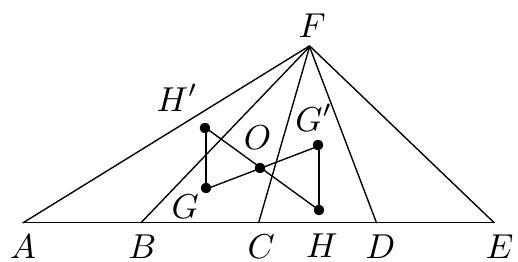 Figure 6
Alternative solution.
Note that the diagonals of a quadrangle are perpendicular to each other if and only if . Applying this to the quadrangle it is sufficient to prove that . Denote , and , and let be the circumradii of triangles and , respectively (see Figure 7). Applying the cosine law to triangles and , we have
and
Together with and this yields . Since and , we also have .
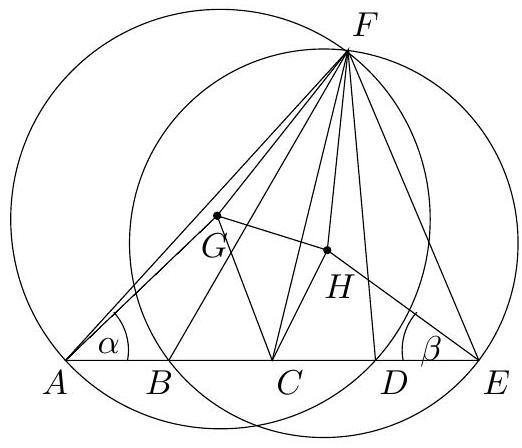 Figure 7
Another solution.
We shall use the following fact that can easily be derived from the properties of the power of a point: Let a line intersect two circles at points and , respectively, and let these circles intersect each other at and . A point on the line lies also on the line (i.e. is the intersection point of the lines and ) if and only if .
The line intersects the circumcircles of triangles and at and , respectively. Since point lies on line and , then line passes through the second intersection point of these circles (see Figure 8) and hence is perpendicular to the segment connecting the centres of these circles.
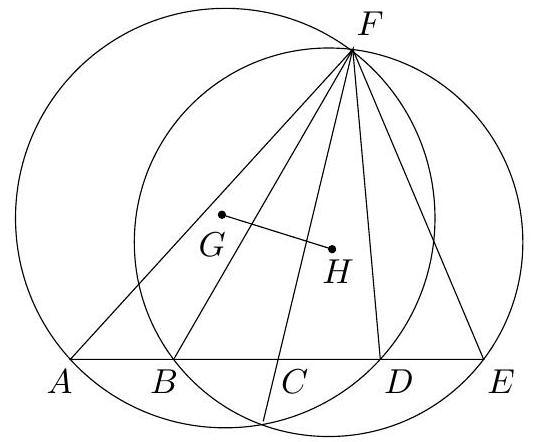 Figure 8
Võistluse kontekst
Balti Tee tulemused 1997
11 võistkonda
- Keskmine tulemus
- 2,7 / 5
- 4 või 5 punkti
- 6 / 11
- Eesti
- 5 / 5
Punktijaotus
Kõigi võistkondade punktid
| Võistkond | Punktid |
|---|---|
| Poland | 5 / 5 |
| Germany | 5 / 5 |
| Estonia | 5 / 5 |
| Sweden | 5 / 5 |
| Denmark | 5 / 5 |
| Latvia | 0 / 5 |
| Finland | 0 / 5 |
| Norway | 0 / 5 |
| St. Petersburg | 0 / 5 |
| Iceland | 0 / 5 |
| Lithuania | 5 / 5 |